Default Reasoning

Construction of sensible guesses when some useful information is lacking and no contradictory evidence is present…

  • Subscribe

  • Disclaimer

    This blog is personal. The views and opinions expressed here represent my own and not those of the people, institutions or organizations that I may or may not be related with unless stated explicitly. All blog post, white papers and manuals were written during the projects, mostly at a customer site and are scenario specific. Use at your own risk.
  • Meta

Archive for the ‘Books’ Category

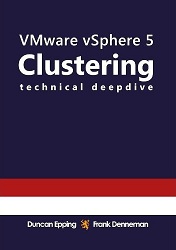
Book review: VMware vSphere 5 Clustering Technical Deepdive.

Posted by Marek.Z on 3 January 2012

The VMware vSphere 5 Clustering Technical Deepdive book has been published a while ago and probably most of you already read it. I purchased the book right after the release and I was reading the book really slowly due to some time management issues. Today, I have finally finished reading this awesome book that was written by Duncan Epping (@DuncanYB) and Frank Denneman (@FrankDenneman) and now it’s time for a little review.

This book consists of more than 340 pages about the most important key features of VMware vSphere 5: the VMware High Availability (HA), VMware Distributed Resource Scheduler (DRS) including Distributed Power Management (DPM) and new in this book is the vSphere Storage DRS (SDRS) which was released in vSphere 5.

The first part of the book concentrates on the vSphere HA and includes topics about the redesigned HA stack, new components like the Fault Domain Manager (FDM) and the new Master/Slave node concept. The new “Datastore Heartbeating” feature and the state where a cluster can be isolated or partitioned are also explained in this chapter.

The second part of the book gives you detailed information about the vSphere DRS. It includes topics about some new features of DRS in vSphere 5 as well as vMotion and EVC. The DRS and DPM calculations and recommendations are extensively explained with good examples and of course the resource pools and it’s control.

Part three of the book is about the new vSphere Storage DRS feature in vSphere 5. In my opinion, this is one of the coolest features of vSphere 5. The chapters in this part of the book will discuss all key features of SDRS like resource aggregation, load balancing, datastore maintenance mode but also how it is calculated and when it is invoked. The Storage vMotion (including the new Mirror Mode), Storage I/O Control and some new enhancement in vSphere 5 are also described in this part.

Part four, called “Integration” is an interesting chapter. It describes the integration points of HA, DRS and SDRS. For example, the sub-topic HA and Stateless ESXi describe what happens with the HA configuration when a host reboots. The topics are small, to the point and give you good understanding about the integration points in vSphere 5.

This is just a small summary of the main topics of the VMware vSphere 5 Clustering Technical Deepdive book, there is a lot more. Just like in the previous version of the book, the basic design principle quotes are also included but not indexed which was the case in the previous book. The technical level is high but the topics are interesting for all VMware enthusiasts. The figures and tables are clear and make some topics easier to understand.

Summary

Although the old HA and DRS Technical Deepdive book is great, the new vSphere 5 Clustering book is even better. I know from twitter that Duncan and Frank worked really hard on this book and managed to complete it just in time the vSphere 5 was released. I guess they really have raised the bar for themselves this time. Just like I said earlier, this book is great and this is the bible you must have read if you are a VMware System Administrator, Engineer, Consultant or Architect.

You can order your copy here or here.

Cheers!

- Marek.Z

Posted in Books, VMware, vSphere 5 | Leave a Comment »

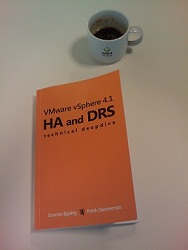
Book review: VMware vSphere 4.1 HA and DRS technical deepdive

Posted by Marek.Z on 13 January 2011

I have finished reading the VMware vSphere 4.1 HA and DRS technical deepdive book written by Duncan Epping (@DuncanYB) and Frank Denneman (@FrankDenneman) so it’s time for a little review.

This book consists of more than 200 pages about the two most important key features of VMware vSphere: the VMware High Availability (HA) and the VMware Distributed Resource Scheduler (DRS). The first part of the book concentrates on the HA and gives you an excellent explanation how the HA works, what are the pre-requisites needed for HA, the concept of primary and secondary nodes. The isolation response and detection, the admission control mechanisms as well as the impact of the chosen admission control policy and of course, the VM Monitoring feature which is, as stated in the book “the bridge between the virtualization layer and the application layer”.

The second part of the book gives you detailed information about the DRS and explains in depth how the resource management works. It provides the cluster settings and automation level overview, when the DRS is invoked and how the recommendations are calculated. It describes the concept of resource pools, shares, CPU/Memory reservations and limits as well as the impact of the reservations and limits in the vSphere environment. Last chapter of the book is dedicated to VMware Distributed Power Management (DPM). This chapter gives you a good understanding of how the decisions are calculated and evaluated when DPM powers a host on or off.

This is just a small summary of the main topics of the VMware vSphere 4.1 HA and DRS technical deepdive book. Believe me, there is a lot more. What I really like is the basic design principle quotes. They become handy when you are designing or building a new virtual infrastructure. All the basic design principles are bundled in the appendix A of the book.

So, to summarize the VMware vSphere 4.1 HA and DRS technical deepdive book I would say that the authors did a really excellent job by putting their experience and brains together to write this great book. The book is understandable and easy to read when you have some experience with VMware vSphere. The topics are provided with illustrations and diagrams that clarify the more complex sub-topics. This book is a “must read” for everyone who is working with VMware vSphere environment and I would highly recommend this book to any Administrator, System Engineer, Consultant or an IT Architect. You can order your copy of the book at Amazon or at ComCol.

One more thing, if you want to know more about HA and DRS, visit the websites of the authors, which are frequently updated. You can find Duncan’s website here and Frank’s here.

Cheers!

- Marek.Z

Posted in Books | 1 Comment »

Giveaway from Microsoft Learning and Microsoft Press.

Posted by Marek.Z on 30 October 2009

Introducing Windows Server 2008 R2

I’ve found this free e-book while I was reading the Microsoft Windows Server Division blog. It’s an introduction to Windows Server 2008 R2 and it’s new features and capabilities. You can download it here.

Happy reading :)

- Marek.Z

Posted in Books | Leave a Comment »

 
Follow

Get every new post delivered to your Inbox.

Join 424 other followers